13 kV RMU Fault Detection
DSP firmware for partial-discharge detection with evidence-rich alerting.
Read case study

Capability
Firmware written by engineers who also lay out the boards it runs on - so the drivers you get were tested against real silicon, not against the reference application. RTOS, bare metal or embedded Linux, chosen for the constraint the product actually meets.
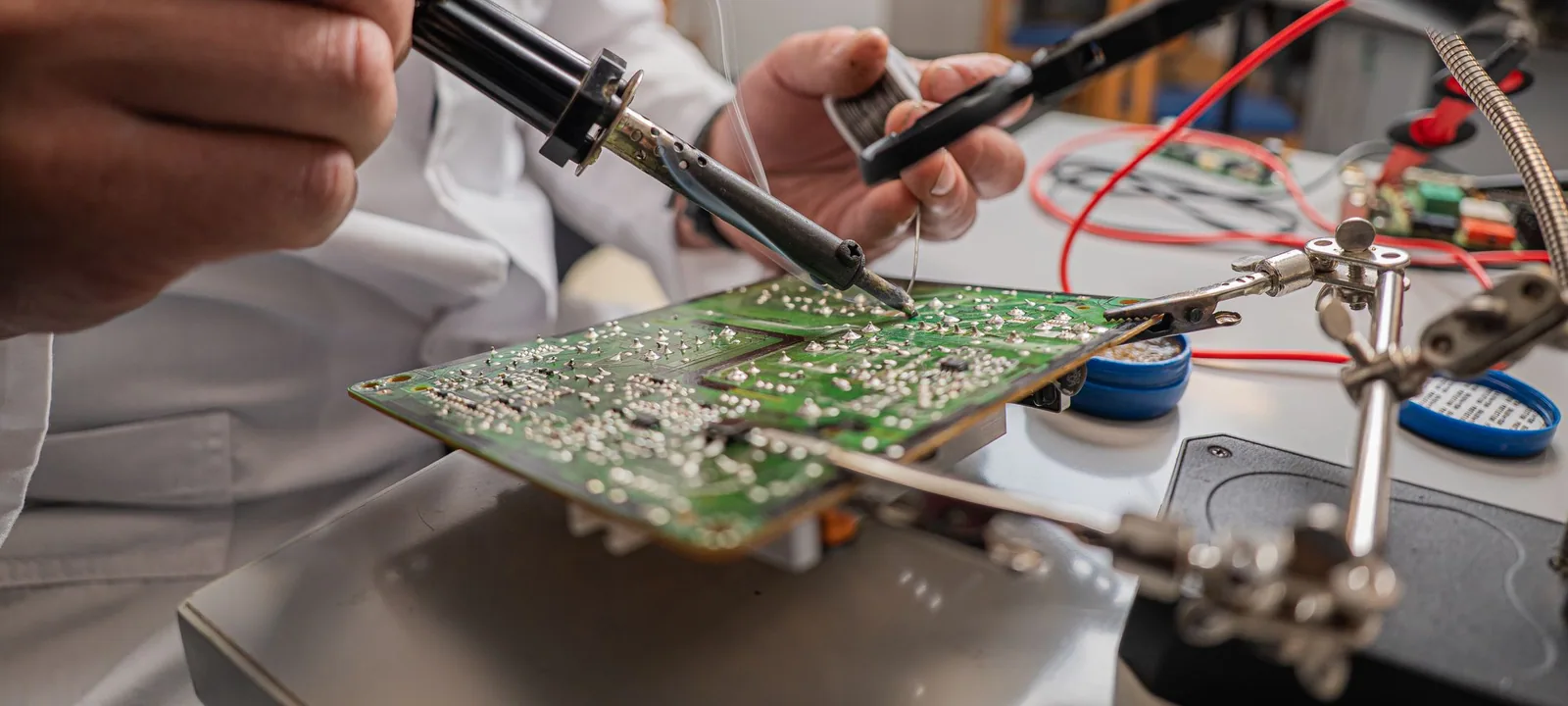
Scope
Firmware is the software that runs on the silicon inside your product. It is judged by how it behaves under real timing budgets, real power budgets, and real field conditions - not by feature checklists. We treat firmware as a systems discipline: the interrupt architecture, the update path and the failure modes matter as much as the features.
Outcomes
Firmware that gets it right is invisible - the product just works. What makes the difference in the products we ship:
Control loops and inference paths that hit their deadlines every cycle, verified against a scope, not a specification. Our weld-inspection firmware grades every weld inside a 45 ms line window, at rate, on the line.
Signed OTA with A/B partitioning and automatic rollback, so a bad update never bricks a fleet. We assume brown-outs, split-brain and half-downloaded packages - because the field will produce all three.
For coin-cell and solar-powered nodes, sleep-mode architecture is designed before the feature list, not tacked on afterwards. Wake sources are measured, not assumed.
HAL boundaries that let a target swap happen without rewriting the application; drivers written to their datasheets, not to the vendor demo; a build system checked into the repo. No secret sauce.
Process
Four phases with a real deliverable at each gate - you always know what you paid for and what ships next.
PHASE 01
We start from the constraint that binds - power, latency, thermal, certification - and design backwards from it. You leave with a written architecture, a budget range and the risks named, whether or not we build it.
PHASE 02
Schematics, mechanical and firmware architecture proceed in parallel. High-risk blocks get simulated or breadboarded before the full layout commits.
PHASE 03
Iterative revisions against real bench and field testing. You see every revision, not just the last one. Integration is continuous, not a phase.
PHASE 04
Pilot in the field, closure with the contract manufacturer, production test procedures, and a commissioning-grade handover pack.
Technologies
The platforms we reach for most. If a project needs something not on this list, we say so - the tool is chosen for the constraint, never to fit our habits.
Industries
Long-life outdoor sensor firmware with cellular fallbacks and OTA.
Grid-side instrumentation firmware with hard real-time constraints.
PLC-adjacent firmware for line controllers and inspection cells.
CAN, telematics and edge inference on cellular-connected devices.
Deliverables & IP
Every firmware program hands over: full source with a documented build system (Make, CMake, PlatformIO or vendor IDE workspace as chosen), CI configuration for reproducible builds, HAL and driver documentation, memory maps, interrupt architecture notes, OTA update tooling and signing keys, production test firmware with factory calibration flows, and a written handover pack a second engineer could pick up cold. All foreground IP transfers on payment.
Case studies
Every entry links to the full case study - constraints, what we built, and what it measured afterwards.
DSP firmware for partial-discharge detection with evidence-rich alerting.
ROS 2-adjacent embedded stack with hard safety interlocks and RTK GNSS.
Ultra-low-power logging firmware for lithium-battery-powered field devices.
Compliance
Secure boot, signed OTA and rollback are the baseline for internet-connected devices we design - not options. Where a product must meet a specific standard (IEC 62443 for industrial cyber-security, IEC 61508 for functional safety, medical or automotive derivatives), we design the firmware architecture to line up with those expectations and say clearly where certified assessors need to join.
Australian radio devices require ACMA-compliant firmware that respects the channel plans and duty cycles of the class licence they ship under; we build the transmit stack accordingly and document the compliance case. For battery-powered devices with lithium chemistries, the firmware is written with the safety envelope in view: over-current, over-temperature, over/under-voltage limits enforced in software as backup to the analog protection, and events logged for field forensics.
FAQ
Why Incendio
Firmware written in isolation from the board it runs on tends to work against reference designs and fail against reality. Because we lay out the boards ourselves, our drivers are tested against real silicon in the same rack the firmware compiles on. The seam between hardware and software is where projects fail - we hold both sides.
Related practices: embedded systems development, PCB design, IoT development, edge AI development.
Start
A latency budget, a power budget, a certification date. We reply within one business day - and we’ll say so if we’re not the right team.